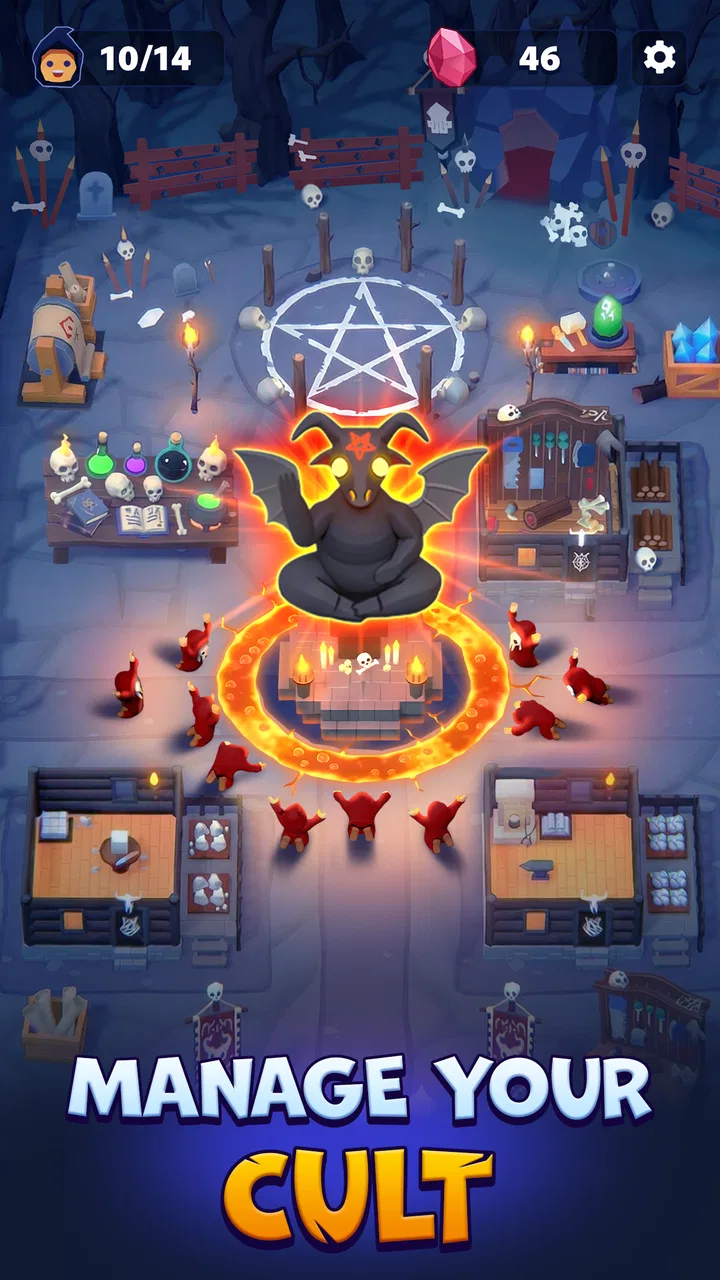
Idle Cult Empire - Evil Tycoon
- 4.4
- Rating
- 1.00M
- Installs
- Free
- Price

 Analysis by App-foxy
Idle Cult Empire - Evil Tycoon is the kind of simulation game I open when I want progress without having to manage every second of play. Its premise is deliberately mischievous: instead of building a normal business or caring for a conventional community, I develop a cult empire and turn it into an idle tycoon operation. That unusual theme gives the familiar “check, upgrade, collect, repeat” structure a more memorable personality.
After spending time with it, I see the appeal clearly. The game is easy to understand, works well in short visits, and gives me a steady sense of development. At the same time, it is not a deep management simulator in the traditional sense. Much of the satisfaction comes from watching a chain of improvements grow rather than from making complicated strategic decisions. If you enjoy incremental progress and playful villainy, this is an entertaining free game to try. If you need constant action, detailed planning, or a fully hands-on simulation, its idle design may feel too light.
How the idle progression feels in everyday play
The first thing I noticed is how quickly the basic rhythm becomes familiar. I look at the current state of the empire, collect what is available, spend resources on improvements, and then leave the game to continue its work. Returning later creates the feeling that my earlier decisions mattered, even when I was not actively playing. That makes it a natural companion for small gaps in the day rather than a game that demands a long uninterrupted session.
You May Also Like

 Blood Strike: 2.5 Anniversary
Blood Strike’s Loadouts Turn Every Drop Into a Tactical Gamble
A close look at Blood Strike’s custom loadouts: how fast access to signature weapons reshapes its battle royale rhythm, rewards preparation, and narrows the gap between fights.

 Pandora - Music & Podcasts
Pandora’s Music Is Easy to Start, but Harder to Recover
Pandora’s strength is its low-effort path from a seed to a station. Its weak spot is how much confidence it asks you to place in connection, setup, and quiet recovery.

 8 Ball Pool
 Is Built on Rivalries, Rematches, and Routine
A close look at the rivalries, rematches, shared routines, and unanswered safety questions that turn a quick pool match into a persistent mobile community.

 Samsung Music
’s Quiet Strength Is Playing What You Already Own
Its reach comes less from spectacle than from dependable access to a personal library. That simplicity is both the app’s strongest retention engine and its ceiling.

 AccuWeather: Weather Radar
AccuWeather Review: A Quick, Clear Forecast for Everyday Decisions
For everyday plans, the best forecast is the one you can understand quickly. AccuWeather makes rain timing, radar, and local conditions easy to act on, with a few trade-offs.

 Hill Climb Racing
Why Hill Climb Racing Still Turns Crashes Into One More Run
A tiny car, a bumpy hill and one more upgrade: Hill Climb Racing keeps resurfacing because its simple chaos makes every near-miss feel personal.
More From Our News Desk
View All News


In practical terms, I can imagine opening it during a commute, checking it while waiting for an appointment, or making a short visit before bed. The game’s identity comes from building a strange empire over time, but the moment-to-moment interaction remains approachable. I do not need to relearn a complicated control scheme each time I return. That low entry barrier is one of its strongest qualities.
The speed of progress is best understood as a gradual climb rather than an instant reward loop. Early improvements can feel satisfying because each purchase has a visible effect on the next stage of development. Later, the same structure naturally asks for more patience. This is where the game divides players: I enjoy the anticipation of the next upgrade, while someone looking for immediate variety may see the waiting as the main weakness.
The best way to play is to treat each visit as a small planning session, not as a full-length action game. I get more from it when I decide which improvement supports my next goal instead of spending everything the moment it appears. That simple habit makes the progression feel more intentional and helps prevent the experience from becoming a mindless sequence of taps.
What makes the cult theme useful rather than decorative
The cult setting gives the game a tone that separates it from cleaner, more familiar tycoon alternatives. Many idle simulations ask me to run a restaurant, city, farm, or business. Here, the central fantasy is intentionally absurd and morally exaggerated. That does not transform the mechanics into a complex strategy system, but it gives the upgrades and empire-building loop a distinct flavor.
I also appreciate that the theme makes the game easier to remember. When several idle games offer similar patterns of accumulation, the setting often determines which one stays installed. This one has a clear identity from the start, and that matters for players who want a simulation with a little dark humor instead of another neutral business backdrop.
Still, the theme will not be enough for everyone. Players who dislike fictional villainy, cult imagery, or the idea of building an “evil” empire should skip it, even if they normally enjoy idle games. The age guidance is Everyone 10+, so I would also use personal judgment before handing it to a younger player, especially if the tone matters more to them than the mechanical rating.
Where the game feels fast and where patience matters
Short sessions feel efficient because the main actions are easy to identify. I can usually understand what deserves attention without spending several minutes searching through menus. That makes the game feel responsive as a routine check-in, even though the larger progression is intentionally slower.
The heavier moments are not necessarily about fast action. They happen when several decisions compete for the same limited pool of resources. I have to choose between an improvement that increases immediate output and one that may help the next stage of growth. This is a modest form of strategy, but it is more interesting than simply pressing every available button.
A useful approach is to keep a small mental priority list. I first look for the upgrade that removes the biggest current bottleneck, then consider whether saving for a more expensive improvement will produce a better return. Spending immediately feels rewarding, but it can also leave the empire stuck just short of a meaningful milestone. That trade-off is one of the few places where careful play noticeably improves the experience.
Another practical tip is to avoid judging the game by one brief visit. Idle progression can feel underwhelming if I expect a major transformation every time I open the app. Its stronger moments arrive through repeated returns, when several modest choices combine into a larger change. This makes it better suited to people who enjoy accumulation than to players who want every session to deliver a dramatic event.
Reliability, device demands, and the cost of playing
Idle games are often chosen because they fit around real life, so reliability matters more here than it might in a competitive action title. My expectation for this kind of design is that the game should be comfortable during quick checks and should not require constant attention to remain enjoyable. Idle Cult Empire is most appealing when it preserves that relaxed relationship with the player: open it, make a few decisions, and return to other tasks.
The current release is version 3.18.1, and the game is available for devices running Android 6.0 or later. That broad operating-system requirement makes it accessible to people who are not using a recent phone. However, an older supported operating system does not automatically mean every older device will feel equally comfortable. Hardware age, available storage, background activity, and the condition of the phone can still affect how any game behaves.
I would be especially realistic about resource demands when using an older or entry-level device. A game can be simple to play while still competing with other apps for memory and battery. If the phone already struggles when several apps are open, closing unused apps before a longer session is sensible. For short visits, the modest interaction style should be easier to accommodate than a graphically intensive action game, but I would not promise identical performance across every handset.
Heavy use is most likely to become noticeable when I spend a longer period repeatedly collecting and upgrading rather than checking in briefly. That is when battery consumption, heat, or slower transitions become more relevant to the overall experience. I would keep expectations practical: this is a game for intermittent attention, and its design does not need to be forced into marathon sessions.
Recovery is another reason I prefer a measured routine. If I leave the game alone for a while, I want to return with a clear idea of what to do next rather than feel punished for taking a break. The idle format is naturally suited to that pattern, although the emotional value of returning depends on whether the accumulated progress feels meaningful to me. Players who enjoy gradual rebuilding will find the pause-and-return cycle comfortable; players who want uninterrupted control may find it less satisfying.
Free access and the pressure to spend
The game is free to download, which makes it easy to test without committing money upfront. It includes in-app purchases ranging from $0.99 to $99.99 per item. That range deserves attention because a free idle title can feel very different depending on how comfortable I am with optional spending.
My advice is to decide on a personal rule before playing. I would first see whether the ordinary progression is enjoyable on its own, then consider purchases only if I understand exactly what problem they solve for me. Spending to remove a temporary wait may make sense to one player and feel completely unnecessary to another. The important point is not to confuse faster progress with better strategy.
This is also where the game differs from a paid simulation. A paid alternative may offer a more predictable experience with fewer reasons to think about optional purchases, while this free model lowers the entry barrier but asks me to manage my own spending discipline. For someone curious about the theme, that trade-off is reasonable. For a player who dislikes any monetization pressure, a premium game may be a better match even if its setting is less distinctive.
How it compares with familiar simulation choices
Compared with a city-building simulation, this game is lighter and more focused. I am not approaching it for detailed zoning, transportation planning, or a large network of interdependent systems. Its pleasure comes from developing one unusual empire through incremental improvements. That makes it easier to pick up, but it also gives me fewer layers to analyze.
Compared with a farming idle game, the difference is mainly personality. Farming simulations often rely on comfort, routine, and a friendly sense of place. This one replaces that warmth with a mischievous “evil tycoon” identity. If I want a calming atmosphere, the farming alternative may be preferable. If I want something more eccentric, the cult theme gives this game the advantage.
Compared with an active management game, the trade-off is even clearer. A hands-on tycoon title may offer more decisions per minute and a stronger sense that every action directly changes the outcome. Idle Cult Empire gives up some of that control in exchange for convenience. I would choose it for background progression and short check-ins, not for a demanding business simulation where every detail needs supervision.
That distinction helps answer an important question: who should install it? I would recommend it to players who like incremental upgrades, humorous fictional settings, and games that can be played in small bursts. I would not recommend it to anyone seeking competitive depth, realistic economics, or constant mechanical variety. It is also a poor choice if the cult theme itself is uncomfortable for you, because the setting is central to the game’s identity rather than a minor visual detail.
What the audience response suggests
The game has an average rating of 4.3 from around 9.5 thousand ratings, with roughly 600 written reviews. It has also passed 500 thousand installs. Those figures suggest that the concept has found a substantial audience, while the written feedback is useful for understanding the usual split around idle games: some players enjoy the relaxing growth loop, and others want more direct control or faster variety.
I would read that response as encouragement to try it, not as a guarantee that it will suit every simulation fan. Ratings are most useful when combined with personal preferences. A strong score cannot turn an idle structure into an active strategy game, and it cannot make the theme appealing to someone who dislikes it. The game’s success is a reason to give it a fair test, while the genre’s limitations remain important.
My performance verdict after weighing the trade-offs
Idle Cult Empire - Evil Tycoon works best as a low-pressure progression game with a memorable setting. Its perceived speed is comfortable for short sessions, while the larger rewards ask for patience. The design should appeal to people who want to make a few choices, leave the game, and return later to continue building. It is less convincing as a long-session simulation because the idle structure naturally reduces the number of meaningful decisions available at any one time.
On device fit, the Android 6.0 minimum makes it approachable for a wide range of phones, but I would still be cautious with aging hardware that already struggles under multitasking. The game’s free entry is another advantage, although the broad in-app purchase range means I would play with a spending limit in mind. Those are not reasons to avoid it; they are simply part of choosing the right expectations.
In my view, the strongest reason to install it is the combination of familiar idle mechanics and an unusual cult-empire fantasy. The weakest point is the same loop that makes it convenient: once the novelty fades, progress can feel repetitive if I need constant interaction. I would give it a try when I want a quirky simulation to check throughout the day, but I would choose a deeper tycoon game when I want complex planning and continuous control.
Overall, Lion Studios Plus has made a free simulation that is easy to approach and distinctive enough to stand apart from ordinary idle businesses. I would recommend it to a friend who enjoys gradual growth, playful dark humor, and games that respect short bursts of attention. I would suggest skipping it if waiting, repeated upgrades, or the cult theme sounds frustrating. For the right player, the simple routine becomes surprisingly pleasant: build a strange empire, make smarter choices over time, and let the next return reveal how far those choices carried it.
FAQs for Idle Cult Empire - Evil Tycoon
01What is the main objective of Idle Cult Empire - Evil Tycoon?
Idle Cult Empire - Evil Tycoon tasks players with building and managing their own sinister cult. The primary goal is to expand your empire by recruiting followers, generating resources, and conducting various dark rituals. As you progress, you'll unlock new features and upgrades to strengthen your cult and increase your influence.
02Are there any in-app purchases in Idle Cult Empire - Evil Tycoon?
Yes, Idle Cult Empire - Evil Tycoon offers in-app purchases. These can range from buying resources, unlocking premium features, or purchasing special items that can accelerate your progress. While the game is free to play, these purchases can enhance the gaming experience and provide quicker advancement.
03Is an internet connection required to play Idle Cult Empire - Evil Tycoon?
Idle Cult Empire - Evil Tycoon can be played offline, allowing users to enjoy the game without a constant internet connection. However, certain features, such as leaderboards or updates, may require you to be online. Playing online can also enable cloud saves and social sharing options.
04How does the progression system work in Idle Cult Empire - Evil Tycoon?
Progression in Idle Cult Empire - Evil Tycoon is achieved by continuously expanding your cult and upgrading your resources. As you unlock new levels and complete tasks, you earn rewards that can be used to enhance your empire. The game encourages strategic planning to efficiently grow your influence and power.
05What age group is Idle Cult Empire - Evil Tycoon suitable for?
Idle Cult Empire - Evil Tycoon is generally suitable for players aged 12 and above due to its thematic elements involving cults and dark rituals. While the game is designed with a humorous and cartoonish style, parental guidance is recommended to ensure the content is appropriate for younger players.
Pros
- Engaging idle gameplay with strategic depth.
- Vibrant graphics enhance the game experience.
- Frequent updates keep content fresh.
- Offline earnings boost progress significantly.
- User-friendly interface for easy navigation.
Cons
- Requires in-app purchases for faster progress.
- Ads can be intrusive during gameplay.
- Limited story content after initial levels.
- Repetitive tasks may become monotonous.
- Some features locked behind paywalls.

Idle Cult Empire - Evil Tycoon
Gallery